I love these sort of films usually (war films where there’s not much war, but smart people behind the scenes doing smart things). But I found this flat and dull. A poor imitation of The Imitation Game. 35% (Find out where to stream it)
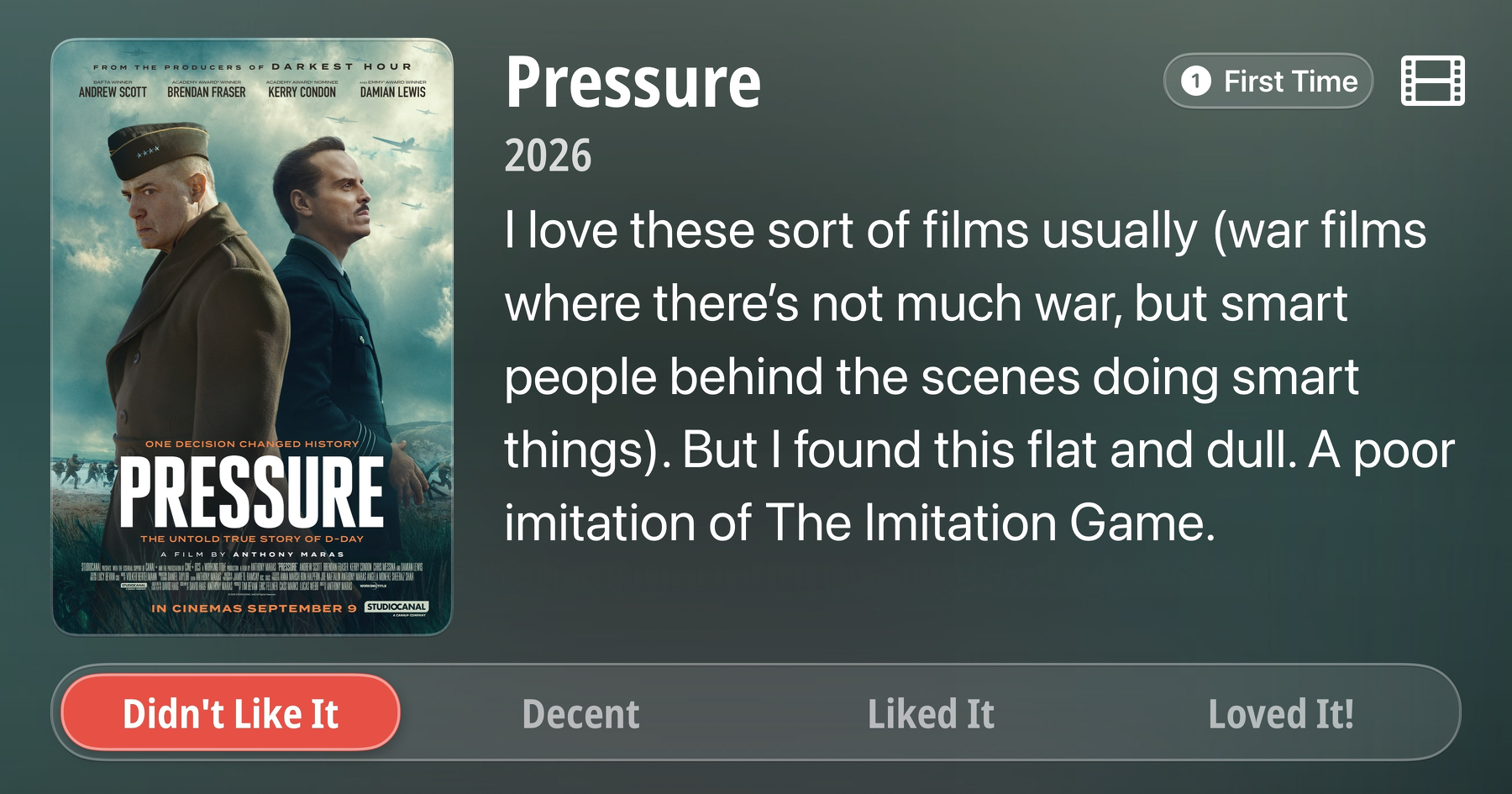
I love these sort of films usually (war films where there’s not much war, but smart people behind the scenes doing smart things). But I found this flat and dull. A poor imitation of The Imitation Game. 35% (Find out where to stream it)
I feel like AI writing is getting worse. I don’t remember it being this bad when it first came out.
I’ve never been especially interested in space or NASA. I find space so intimidating to learn about. And it hurts my brain if I think about it too much – the vastness of it all. It’s a real blind spot in my knowledge. And I must fix that. But watching the film “Apollo 13” has stirred my imagination. I haven’t got to the end of the film yet, but I’m really enjoying it. I like films about people “working the problem”. And one question I’ve always had about Apollo 11’s mission to the moon is: how did NASA get all this near-realtime data in the 1960’s‽ Voice, telemetry, etc. Well, I found out.
They got all this data via something very simple: radio.
The Moon is ~384,000 km away. Radio signals travel at the speed of light, giving a one-way delay of ~1.3 seconds (~2.5 seconds round trip). This is why there’s a noticeable pause in all Apollo mission audio.
NASA used a global chain of stations ensuring one was always facing the Moon as Earth rotated (radio needs line of sight). Key stations: California and two in Australia.
The spacecraft used a steerable high-gain dish antenna to beam a focused signal back to Earth.
A single radio link carried multiple streams simultaneously (multiplexed):
The full chain:
0, the other way = 1)As I was learning all of the above, my digitally minded brain was confused how it could be done without something like JSON. But no metadata or labels were used. Instead: time-division multiplexing with a fixed frame structure. Before launch, both the spacecraft and ground agreed on a fixed, hardcoded schedule — the multiplexer always cycled through sensors in the same order at the same rate. Position 1 was always sensor X, position 2 always sensor Y, and so on. The ground just counted positions; no labelling needed.
To mark the start of each cycle, a sync word (a distinctive fixed bit pattern) was transmitted at the beginning of each frame. When the ground decoder spotted it, it reset its positional counter.
Readings were organised in two tiers:
This was extremely efficient — zero bandwidth wasted on metadata — but brittle. If sync was lost, the system had to wait for the next sync word to re-lock.
A beautifully simple combination of analogue and digital. Remarkable.

I just learnt: there’s more than one Alexandria, as Alexander the Great would name the cities he conquered after himself. Plutarch claims seventy in total.
Papyrus: The Invention of Books in the Ancient World by Irene Vallejo 📚:
There is no single Alexandria. A series of cities by that name traces the route of Alexander the Great from Turkey to the Indus River. Different languages have distorted the original sound, though sometimes the distant melody can still be discerned. Alexandretta, Iskenderun in Turkish. Alexandria Carmania, currently Kerman, in Iran. Alexandria Margiana, now Merv, in Turkmenistan. Alexandria Eschate, which could be translated as “Alexandria at the End of the Earth,” today Khujand in Tajikistan. Alexandria Bucephalos, the city founded in memory of the horse that accompanied Alexander from childhood, afterward called Jalalpur, in Pakistan. The war in Afghanistan has made us familiar with other ancient Alexandrias: Bagram, Herat, Kandahar.
Plutarch tells that Alexander founded seventy cities. He wanted to mark the fact that he had been there, the way children paint their names on walls or on the doors of public restrooms. (“I was here.” “I won a battle here.") The atlas of his campaigns forms an enormous wall where the conqueror left a record of himself again and again.
Some of my favourite “dipping” books are the miscellanies and almanacs by Ben Schott. But I’d never been fully sure what the difference between the two was. But I’ve learnt:
A miscellany is a collection of varied information with no organising principle beyond interest and surprise — from Latin miscellanea (“a mixture”). The format has roots in Roman and early modern English literature; Ben Schott’s Miscellany (2002) revived it as a modern trivia cabinet. Dip in anywhere; there’s no order to follow.
An almanac is fundamentally calendar-structured, tracing its name to Arabic al-manākh (“the calendar”). Historically contained astronomical data, weather predictions, feast days, and seasonal guidance. Old Moore’s Almanack (1697) and Benjamin Franklin’s Poor Richard’s Almanack are classic examples — practical tools as much as reading matter. Ben Schott’s almanacs follow this time-anchored tradition, organised by month and season.
Key distinction: miscellanies are timeless and structureless; almanacs march through the year.

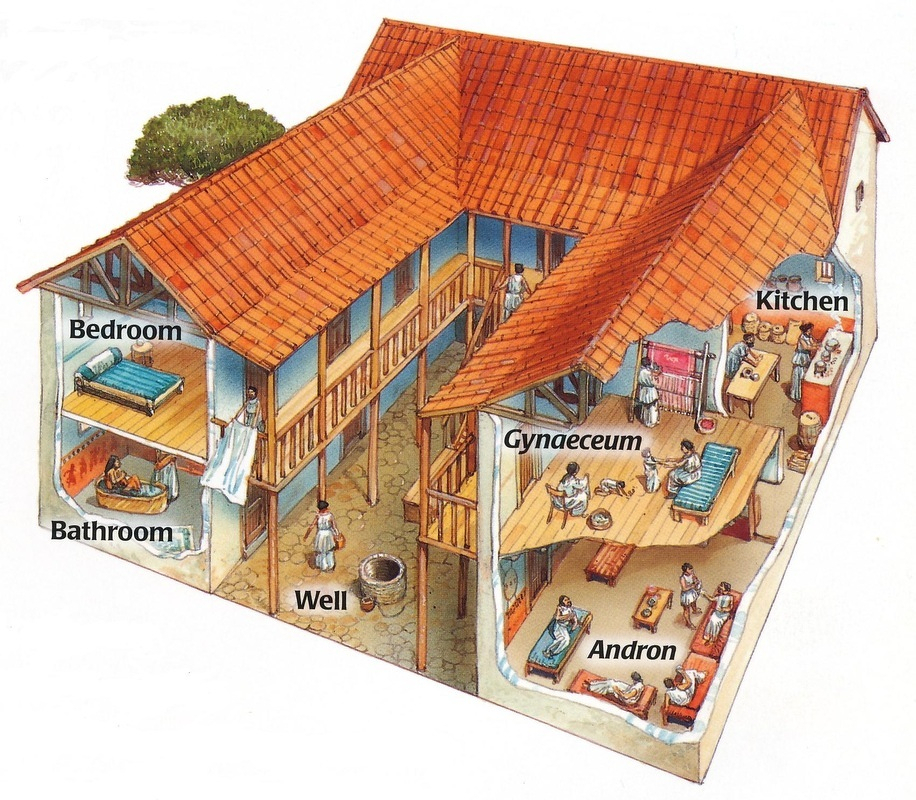
A gynaeceum (or gynæceum) refers historically to the women’s quarters or inner, secluded apartments in an ancient Greek or Roman house. As the counterpart to the male andrōn, this area was typically located in the innermost part of the home for women’s activities like weaving.
The men’s room – the andron – was positioned near the front, accessible to male visitors. The gynaeceum was typically at the rear or on an upper floor, accessible to family only. It was where women spun, wove, raised children, and ran the household economy. And I’m sure it was a lot more bare bones than the men’s room!
Apparently having the wealth to hide your wife away in a gynaeceum was an elite ideal. As the wives of poorer households would go to markets, wells, and shrines.
I remember reading once that Ancient Greece was more like a strict Muslim city than a city of democracy, knowledge and philosophy. Women being “locked away” in a gynaeceum certainly attests to that argument.
#NewWord learnt via Papyrus: The Invention of Books in the Ancient World by Irene Vallejo 📚
There are few feelings more delightful than finishing a book and slowly perusing your bookshelves for your next read. Returning with a big pile of contenders, before ultimately choosing your next read.
Currently reading: Papyrus The Invention of Books in the Ancient World by Irene Vallejo 📚
Many are worried that the rise of realistic looking AI video tech will lead to fake videos of people doing bad things to smear their name.
But another worrying side effect of AI is how people will cry out “it’s AI” to genuine videos, just because they don’t want to believe it’s real – or want to convince others that it’s not real.
AI creates plausible deniability.
I see this battle over truth every single day in the comments on social media.
This was a few of the comments on a video about abuse in Romanian orphanages:








More people have tumblelogs/microblogs than you think – it’s just not called that. Take Instagram stories. People “reblog” others stories, share the music they’re listening to, post what they’re eating, poetry and often their own writing. They’re sharing themselves online. And thats all blogging is.
(I’ll be honest, I kind of watched this in the background) I had fairly high hopes for this film – it had good reviews and seemed fun. But it didn’t entirely work for me. The “gentleman villain” parts kind of worked and gave an okay backbone to the film. But whilst fun, it just lacked a bit of life. There’s an elite cast on display and they all do great (Kristin Dunst especially), but the film felt pointless at times 50%